This week, I analyzed Filipino
identity construction and its relationship with colonial mentality. David and
Okazaki identify colonial mentality as a “form of internalized oppression
following colonialism” that is characterized by “an automatic and uncritical
rejection of anything Filipino and an automatic and uncritical preference for
anything American” (2006, p. 241). Their study hypothesized and found possible
results that this mentality is passed through socialization, which became more
apparent during our discussion at the Philippine Women’s University (David
& Okazaki, 2006, p. 249). At our group discussion between students and
faculty at PWU, both the students and the faculty used terms such as ‘pure’ and
‘full’ American instead of ‘White’ because they assumed to be American a person
had to be White. Because both students and faculty used the same term, it
exemplified that miseducation is passed down through generations and that
education aids socialization.
Miseducation, which spurs colonial
mentality, is a product of colonial education from Spain and the United States
in the Philippines. According to Constantino, the Filipino tendency to be “naïve
and trusting in its relations with foreigners, devoid of the capacity to feel indignation
even in the face of insults to the nation” is due to the fact that “colonial
education has not provided [them] with a realistic attitude toward other
nations” and has instead emphasized the “gifts that [their] conquerors have
bestowed” (1982, p. 186). The Americans used education as a war tactic in the
Philippines, to brainwash the Filipinos to adopt the American culture and
government structure. According to Andresen’s “Knowledge Construction, Transformative
Academic Knowledge, and Filipino American Identity and Experience,” the
reeducation of Filipinos using an American framework created a “Filipino
American identity that rendered their Filipinoness invisible and no different
from the other Asian Pacific Americans in American society” (2012, p. 73).
Miseducation has greatly impacted the ability for Filipinos to construct a unique
identity.
One of the leading factors in
rendering Filipinoness invisible is the use of English in the classroom.
Constantino explains that using English rather than the native languages
impedes learning due to both the focus on memorization of word and sentence
meanings rather than understanding and the difficulty of expression which leads
to a lack of deep thinking among parts of the Filipino population (1982, p.
189-190). He also asserts that “experience has shown that children who are
taught in their native tongue learn more easily and better than those taught in
English” (Constantino, 1982, p. 190). This was apparent at the PWU discussion when
terms such as pure, full, half, and American were not universally defined or
understood in the same way despite being spoken in the same language; the
connotations of these terms were completely lost in translation.
Lastly, David & Okazaki
also connect four acculturation strategies—assimilation, integration, separation,
and marginalization—as different manifestations of colonial mentality as shown
in Figure 1, where assimilation is having high identification with the dominant
culture and low identification with the heritage culture, integration is having
high identification with both, separation is having low identification with the
dominant culture and high identification with the heritage culture, and
marginalization is having low identification with both (2006, p. 242).
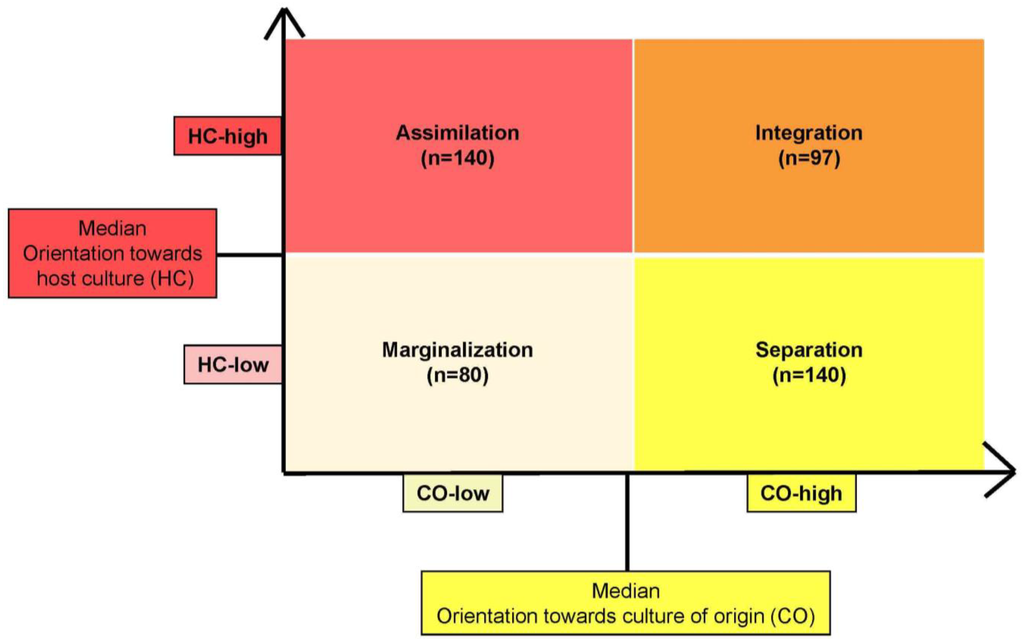
Figure 1. A chart from MDPI that visualizes the four acculturation strategies
identified by David & Okazaki.
In the movie “Slow Jam King,” the
protagonist JoJo exemplifies assimilation because he attempts to act like a
pimp in order to fit in with the dominant crowd though he later struggles with
who he really wants to identify as later on. This relates back to the David
& Okazaki study where they support that those who are more assimilated may
identify less racist events, perhaps because they are less aware of them or feel
that they are less likely to happen if they try to fit in with the dominant
culture (2006, p. 250). However, it is easiest for me to identify assimilation
when it comes to Filipino identity construction versus the other acculturation
strategies. I am interested in exploring the following: how do integration,
separation, and marginalization manifests in Filipino identity construction and
what factors affect which strategy is utilized?
References
Andresen, T. (2012). Knowledge
construction, transformative academic knowledge, and Filipino American identity
and experience, In E. Bonus & D. Maramba, (Eds.) The “other” students: Filipino Americans, education, and power.
(pp. 65-87). Charlotte, NC: IAP.
Constantino, R. (1982). The Miseducation
of the Filipino. In I In A.V. Shaw & L.H Francia, Vestiges of war. (pp. 177-192). New York: New York Press.
David, E. J. R., & Okazaki, S.
(2006). The Colonial Mentality Scale (CMS) for Filipino Americans: Scale
construction and psychological implications: A review and recommendation. Journal of Counseling Psychology, 53
(1), pp. 1–16.

No comments:
Post a Comment